

Emissions and Climate Adaptation
About
AFII Strategic Focus areas engage Theme AFII engages Theme Leads who work with the AFII team to build collaborative networks across the university. They also create events and activities that build capability and explore new approaches.
Theme Leads, Wolfram Buss (Fenner School of Environment & Society) and Saule Burkitbayeva (Faculty of Law) discuss how ANU brings multidisciplinary expertise to Emissions and Climate Adaptation challenges in Agrifood.
Agriculture must stay productive while adapting to a changing climate and reducing its greenhouse gas footprint. Farmers are already grappling with hotter, drier seasons, shifting rainfall, more frequent extremes, and rising input costs. At the same time, markets and regulators are demanding credible emissions reporting and stronger environmental performance across the whole agrifood value chain.
What are the future challenges?
Over the next decade, the agriculture industry will need to:
- Cut on-farm and supply-chain emissions in line with government targets and community expectations while keeping businesses profitable.
- Adapt crops and livestock to heat, drought, frost, floods and emerging pests and diseases.
- Manage water under more variable rainfall and competing demands.
- Protect soils, rebuild soil carbon and maintain productivity on degraded land.
- Integrate biodiversity into working landscapes without sacrificing yields.
- Tracking, verifying, and reporting emissions to meet policy and market requirements.
- Support businesses and communities through the transition.
How can we help reduce emissions in agriculture?
At ANU, we are tackling one of agriculture’s biggest challenges: staying productive while adapting to a changing climate. Through our emissions and climate adaptation work, we bring together research, education, and collaboration to build farming systems that are both sustainable and resilient.
We co-design solutions with government, industry, and businesses to ensure they are practical and useful. We facilitate projects that are:
- Reducing emissions from farming and the broader agrifood value chain, including livestock, fertiliser use, energy, and logistics.
- Developing crop and livestock practices that withstand heat and drought, and improving biosecurity under a changing climate.
- Using models and decision tools to predict and manage climate risk at farm, regional, and supply-chain scales.
- Testing technologies and management strategies to improve water use efficiency and reliability.
- Restoring soil function, lifting soil carbon, and improving nutrient efficiency to protect productivity.
- Embedding biodiversity outcomes in farming systems and landscape design.
- Designing credible measurement, reporting, and verification approaches that support strong, fair markets.
- Understanding social and consumer drivers so adaptation policies and products are accepted and effective.
ANU offers world-class facilities to support this work, from climate simulation laboratories and soil science centres to water research hubs and biodiversity expertise. We also invest in workforce training to equip the next generation with the skills needed for emissions reduction and climate resilience.
Partner with us to future-proof your operations. Whether you're seeking strategic insights, technical solutions, or collaborative innovation, we’re here to help you lead in a climate-smart agricultural future.
News and Solutions

As pressures on Australia’s food system grow, the need to connect research, policy and industry has never been greater. This article explores food sovereignty, resilience and the role of innovation in securing our future. Read more and be part of the conversation.

Rising fuel costs are exposing a bigger risk to Australia’s food system. But ANU researchers are helping chart a path forward, exploring low-carbon fuels and stronger supply chains to boost resilience. Discover how local innovation could help protect farmers, strengthen food security and reduce future costs.
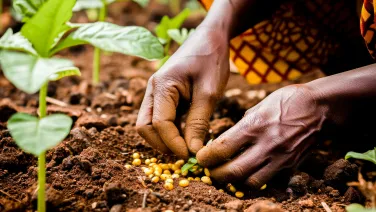
To support our emerging talent, AFII is offering several sponsorships (valued at up to $670 each) for Early Career Researchers (ECRs) and postgraduate students to attend the 2026 Crawford Fund Conference.

Discover how Australian farms can produce food and clean energy together. A new multi‑university project led by Dr Marco Ernst is testing agrivoltaics to accelerate net‑zero farming and strengthen rural resilience.

Explore how embedded emissions accounting is reshaping agriculture’s climate impact. Learn why harmonising farm-level carbon tools is key to reducing emissions, boosting climate resilience, and meeting Australia’s 2035 targets. Essential reading for agri-research and sustainability.

The Agrifood Innovation Institute will support up to six ANU students (undergraduate or postgraduate) to attend the National Renewables in Agriculture Conference in Bendigo on 23 July 2025.