
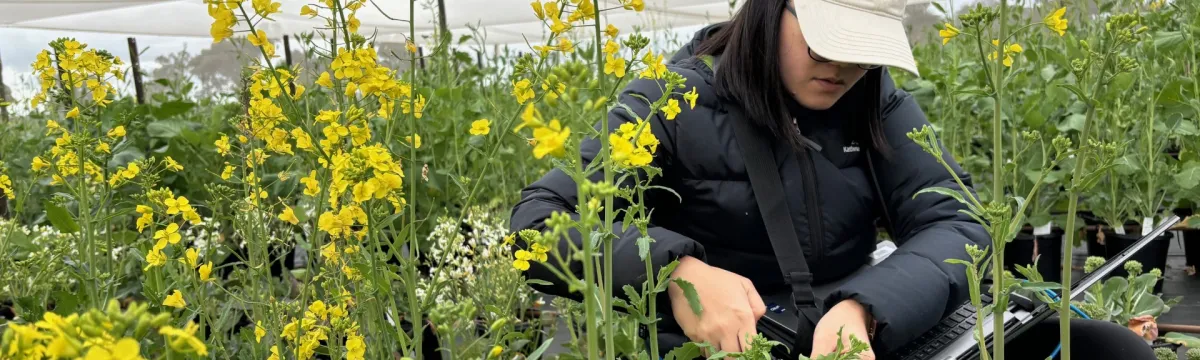
Reimagining canola crops for climate resilience
Canola is one of Australia’s most valuable oilseed crops, yet it is highly vulnerable to climate extremes. Growers consistently identify drought, frost and heat stress during flowering as the greatest risks, since even short events can cause flower abortion and dramatically reduce seed and therefore oil production. With climate variability increasing, farmers have little control once the crop is in the ground.
An innovative proof-of-concept project to start in late 2025, led by Dr Florence Danila with funding from Grains Research and Development Corporation, aims to give farmers a new level of flexibility to enable them to adapt to increasing climate risks.
The research team is testing “inducible genetics” in canola crops that can be switched from oilseed production to biomass production for biofuels if severe weather is forecast. Farmers could make this switch by applying a simple agrochemical spray, or the plants could be programmed to trigger automatically when thresholds of temperature or stress are reached.
The project leverages advances in synthetic biology, adapting genetic “switches” originally discovered in bacteria to create programmable crops. The first stage will test the concept in Arabidopsis, a close relative of canola, before transferring successful results into commercial varieties.
If successful, this work could transform risk management in oilseed farming, offering farmers both resilience to climate shocks and new revenue streams from biomass, while supporting the transition to low-emission biofuel production.
Related article: New technology to improve canola yields
Partner with us to future-proof your operations. Whether you're seeking strategic insights, technical solutions, or collaborative innovation, we’re here to help you lead in a climate-smart agricultural future.