

Response to the Australian Government’s Strategic Examination of Research and Development Final Report
The Agrifood Innovation Institute welcomes the release of Ambitious Australia: Strategic Examination of Research and Development and thanks the Australian Government for undertaking the first comprehensive review of the Nation’s research and development system (R&D) in almost two decades. The response to the review from stakeholders across the country reflects the importance of this work and the opportunity to strengthen Australia’s innovation capability.
Australia’s agrifood system sits at the intersection of many of the challenges identified in the report: productivity growth, climate resilience, sovereign capability and regional prosperity. Research and development in agriculture and food systems is one of the most reliable sources of long-term productivity growth and national economic benefit.
We are encouraged to see several themes raised in our submission reflected in the report’s findings.
First, the report recognises the need for clearer national coordination of Australia’s fragmented R&D system. The proposal for stronger national leadership and streamlined governance, through a National Innovation Council and National Strategy Advisory Councils, would be an important step towards reducing duplication and aligning investment with national priorities.
Second, the report acknowledges the importance of mission-style investment in strategic sectors, including the identification of agriculture and food as a National Innovation Pillar. Positioning agrifood alongside other priority areas such as health, energy and defence recognises the sector’s central role in economic resilience and national security.
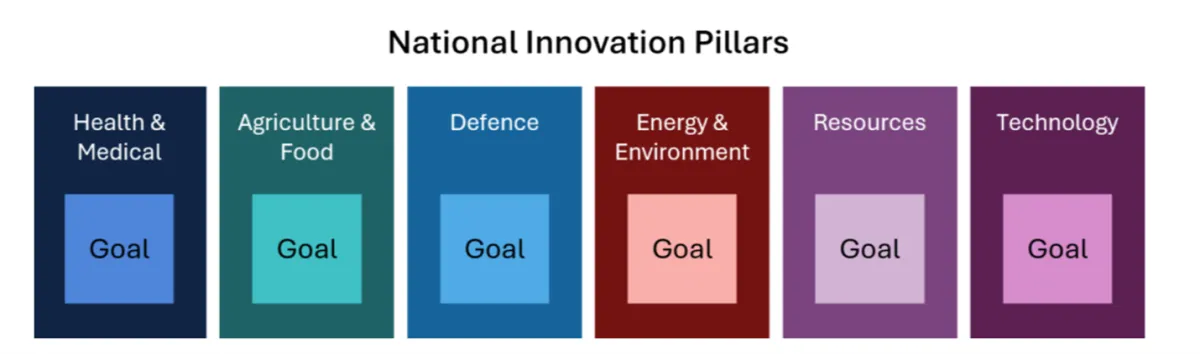
Third, the review highlights the need to strengthen connections between research, industry and commercial outcomes.This closely aligns with the model already used by AFII, which brings together governments, industry, and the research sector to accelerate both foundational and applied research and support translation into real-world innovation.
Many of the report’s recommendations, including the proposed National Strategic Initiatives, reflect the type of coordinated, public-private collaboration that AFII is already working to build. Through initiatives such as the AFII Hub, we are helping to provide a ‘front door’ for industry to engage with university research capability and infrastructure, while supporting partnerships that connect businesses, researchers and investors to tackle complex challenges.
The report also identifies several barriers that organisations like AFII have encountered in practice, including short funding timeframes, limited appetite for tackling complex, cross-disciplinary challenges, siloed research structures, and declining public investment in research. Addressing these structural issues will be essential if Australia is to realise the ambitions set out in the review.
We were encouraged by the strong emphasis on industry-connected research training. AFII already supports many of the elements proposed in the report, including industry placements, entrepreneurial training and stronger links between research students and the workplace. These approaches help ensure that the next generation of researchers is equipped to work across academia, industry and government.
As the Government considers the next phase of reform, three priorities will be particularly important for the agrifood sector.
- The National Innovation Pillar for agricultural and food needs to link food security, climate resilience and economic growth. We need to acknowledge the scale and strategic importance of the agrifood system to Australia’s economy, regions, and national resilience. We need mission-style investment that aligns research investment across science, economics, law and regulation, and the social sciences, recognising that a multidisciplinary approach is essential to solving the complex challenges facing the sector.
- Long-term, coordinated investment in agrifood research translation is essential. Australia has world-class science but often struggles to scale and commercialise innovations locally. Dedicated mechanisms that bridge research, industry and investment will be critical.
- Strengthening collaboration across the agrifood ecosystem will be key. Connecting universities, research agencies, industry, producers, and regional partners will ensure that research outcomes translate into real benefits for farmers, businesses, and communities.
This review presents a rare opportunity to reshape Australia’s innovation system for the decades ahead. AFII looks forward to the Australian Government’s response to the recommendations and to how it will support the Australian R&D sector to thrive.