
Delivering national field research at scale
Running field research across a counrty as vast as Australia can be as demanding as the science itself. The Heat Tolerance Project shows what it takes to deliver complex, multi-site agricultural research under real world conditions - and to keep it moving when the weather and the plants don’t cooperate.
The project set out to screen around 200 wheat varieties across four contrasting environments at Narrabri, Parkes, Griffith in New South Wales and Merredin in Western Australia. These sites were selected to represent major growing regions and expose wheat to different heat and rainfall patterns. What looked like a straightforward experimental design on paper quickly became a logistical challenge on the ground. Each location had its own seasonal timing, irrigation schedules, and weather risks, meaning field campaigns had to be reshaped constantly to match crop development.
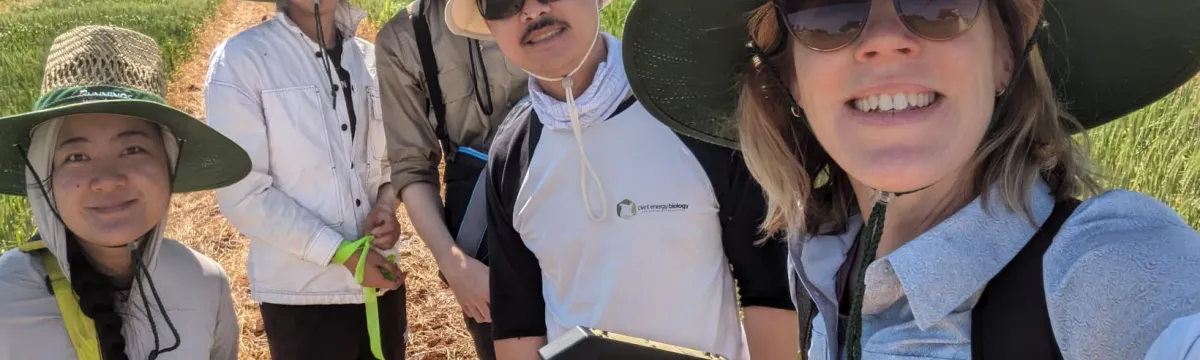
A large national team made this possible. Around 30 collaborators across universities, research agencies and field partners worked together to coordinate logistics, resourcing, sampling protocols, and field measurements over three seasons. As Project Manager Frederike Stock described it, the first year felt “like herding cats,” not because people were not committed, but because aligning equipment, trained staff, travel, and a narrow sampling window across states is inherently difficult.
The field work also required specialised equipment rarely used at this scale. The team deployed a robotic system, originally designed for seeds, to measure photosynthesis and respiration rates of hundreds of leaf samples per day. Weighing around 100kg, transporting, calibrating and operating that equipment consistently at remote sites demanded careful planning and troubleshooting. Early on, subtle differences between machines led to unexpected variations in results. This prompted extra site visits and tighter calibration routines, while an error-prone sampling design in the first season drove the move to a streamlined sampling design in later seasons.
Heat waves and drought added another layer of pressure. Campaigns were often scheduled at short notice to capture crops at the right developmental stage before conditions shifted again. Travel and accommodation were rearranged repeatedly, and staffing had to remain flexible to ensure every site was measured to the same standard.
By the end of three seasons, the project has not only generated one of the largest datasets of its kind in Australia, but it has also demonstrated how coordinated field science, strong partnerships and adaptive management can deliver research at the scale Australia’s future agriculture demands.
Related article: Using machine learning to identify heat tolerant wheat varieties