
Engineered living silk that keeps working after it's made
Most materials used to hold and transport products are inert objects. Once manufactured, their structure and properties are fixed. But what if they could do more than just be storage? What if they could help keep fruit fresher for longer, protect crops from disease, or replace plastics with biodegradable alternatives?
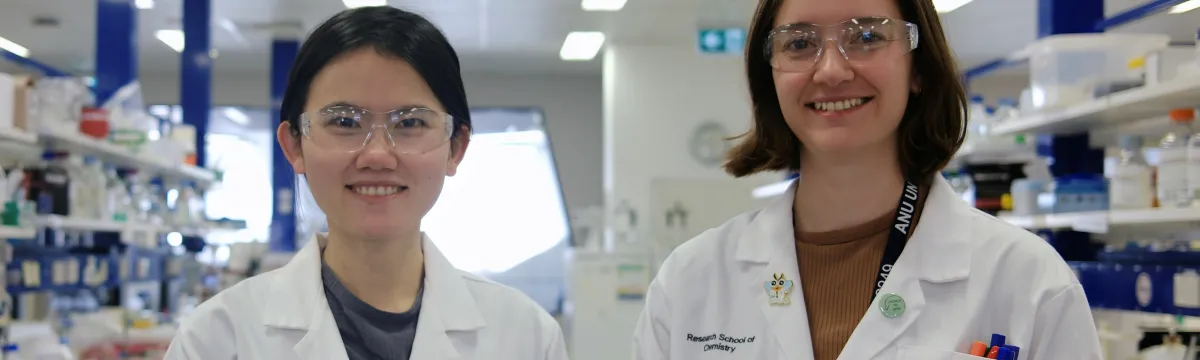
These are the kinds of questions ANU researchers Bini Zhou and Alexandra Coram are exploring with a new engineered silk: a biodegradable material designed to remain active and functional long after it leaves the laboratory.
Based in the ANU Research School of Chemistry, the pair are developing a new silk protein produced through microbial fermentation rather than harvested from silkworms. Drawing on an ancient silk sequence, they have engineered a version that remains soluble, making it easier to process into films, coatings and gels.
To give the material an active biological function, the team fused the silk protein with an enzyme that breaks down a component of the cell walls of many crop-damaging fungi. They then engineered E. coli to produce the material and assembled it into a fibrous network, creating a protein that retained both its structure and its antifungal properties.
The technology has potential applications across agriculture. It could be used as a protective coatings for seeds and plant surfaces to biodegradable antifungal packaging that helps extend the shelf life of fruit and vegetables without relying on plastic or chemical sprays. The material could also form part of engineered living hydrogels to support healthier soils and root systems.
The team's next challenge is demonstrating that the material performs reliably outside controlled research settings. If successful, the technology could offer a sustainable new way to protect crops and reduce waste across the agricultural supply chain.
Bini and Alexandra’s work highlights how a single piece of synthetic biology research can translate from the lab to deliver benefits across the agricultural supply chain, exemplifying the kind of end-to-end impact ANU is well positioned to create.
Researcher bios
Bini Zhou is a Postdoctoral Fellow who was drawn to work on research that sits at the intersection of many disciplines. Working across synthetic biology and materials science at ANU, she's driven by the challenge of designing materials that stay alive and functional after they're made, rather than treating biology purely as a manufacturing tool. Her current work fuses engineered silk proteins with antifungal enzymes to protect crops and soil health. For Bini, what makes the work exciting isn't just the science, it's the range of fields it touches, from agriculture to medicine to materials design, and the chance to build something genuinely new out of that overlap.
Alexandra Coram is a PhD candidate who came to synthetic biology through a fascination with what nature has already solved. "There are millions of years of innovation" in natural materials, she says, and her research is about learning to build from that innovation rather than simply harvesting it. Working alongside Bini Zhou, she's developed a new soluble silk protein produced through microbial fermentation, part of a broader push to replace petroleum-based plastics with naturally inspired, biodegradable alternatives. She's motivated by the scale of the waste problem industrial materials create, and by the belief that biology, engineered carefully, can do better.