
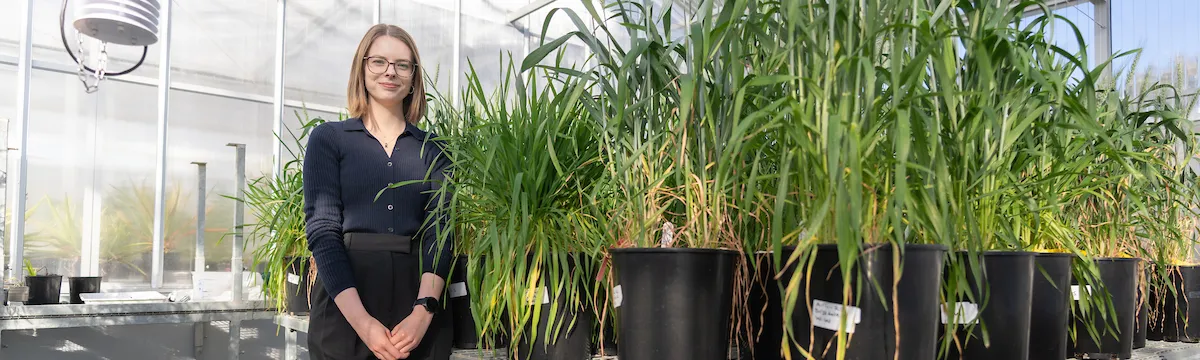
Using science to rethink sustainability: Dr Samantha McGaughey - ACT Emerging Scientist of the Year
For Dr Samantha McGaughey, science is about learning from nature to solve real-world problems.
As her term as the 2025 ACT Emerging Scientist of the Year comes to an end, the Australian National University (ANU) Research School of Biology researcher is reflecting not only on the recognition, but on the opportunities it created to connect science with the broader community.
Awarded for her work developing new technologies to recover valuable nutrients and metals from wastewater, Dr McGaughey said one of the most rewarding parts of the experience had been engaging with students and young people interested in science.
“There were so many opportunities to connect with the community through the award,” she said.
Over the past year, she has participated in the National Youth Forum launch, spoken at the Curious Minds summer camp for girls interested in STEM, and judged primary school science fairs. She is also looking forward to connecting with students at the ACT Student Conference in June.
Her advice to future recipients is simple: “Say yes,” she said. “There’s a hectic period after receiving the award, with lots of speaking opportunities, but I’m really glad I did it.”
At the centre of her research is a simple but powerful idea: waste can become a resource.
Working with startup Membrane Transporter Engineers (MTE), based in the Agrifood Hub, and with collaborators from CSIRO through the Agrifood Collaboration Program, Dr McGaughey has been helping to develop plant-inspired membrane technologies that can recover substances such as ammonia from wastewater and potentially convert them into reusable fertilisers.
Over the past year, the team reached a major milestone by developing their first biomimetic membrane prototype.
The research remains in the development phase, with the long-term goal of supporting more sustainable and circular approaches to water, nutrient and waste management.
For Dr McGaughey, the project highlights the importance of thinking differently about agriculture and sustainability.
“We need to reimagine what we mean by agriculture,” she said. “Water management and wastewater management are a really important part of sustainable food and environmental systems.”
Her research journey began in plant biology, where she studied how plants transport nutrients and withstand stress. During her PhD, she drew inspiration from technologies developed by NASA for the International Space Station, sparking ideas about how biological systems could inspire new environmental technologies on Earth.
For AFII, Dr McGaughey’s work highlights the growing role of multidisciplinary science in shaping the future of sustainable agriculture, water management and environmental resilience. It also reflects AFII’s strategic focus on translating world-class research into real-world impact through industry collaboration, innovation and solutions that support more sustainable food and environmental systems.