
From the Director: August 2026
A fortnight ago, ANU released its new strategic plan, ANU by 2030. For many, a new organisational strategy can signal a time of change. For AFII, though, it confirms we are already heading in the right direction, operating in a way the university now wants to see more broadly across ANU.
ANU by 2030 does two things that resonate strongly with us. First, it puts real emphasis behind the university’s role in convening national conversations – bringing together the expertise, industry perspective and government insight needed to work through problems no single organisation can solve alone.
Late last year, we did exactly that, convening a conversation with experts from industry, researchers, research development corporations, growers, and government agencies to discuss the barriers to the adoption of biological control products. Following the release of our first report, we ran a second workshop in July, this time bringing together international experts to understand where other countries have found success and where they’ve hit pain points in getting biocontrol products through regulatory systems. We wanted to understand not only the barriers in the Australian industry, but also what we can learn from countries that have advanced further in the use of these products. A full report is coming in the weeks ahead and will show that a single conversation isn’t as effective at creating solutions as longer-term collaboration to get to the root of the problem.
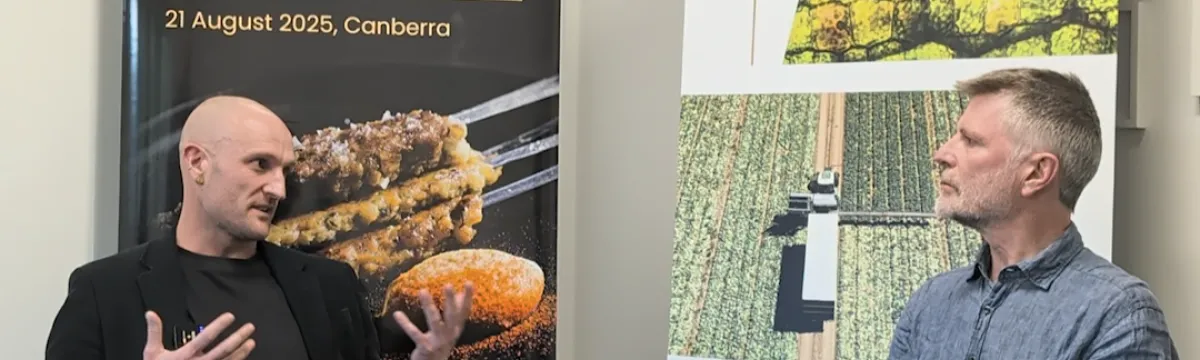
Our event last year with Cellular Agriculture Australia and the ANU National Security College, Made and Grown, is another example of that convening role. We released a new video this month reflecting on the value of that event in building understanding of the challenges in biomanufacturing and of the technology already available. While we were together, Dr Sam Perkins, CEO of Cellular Agriculture Australia, and I talked about the value of building the Made and Grown brand to keep the conversation about biomanufacturing going and to expand it beyond food.
The second area that resonated strongly for AFII from the ANU strategic plan is the commitment to a transdisciplinary problem-solving agenda. Biocontrol, biomanufacturing, low-carbon liquid fuels, and heat resilience are the examples I keep coming back to this year when we talk about the value of interdisciplinary work, because each is already a case study in the benefits that can come from bringing together diverse ways of thinking.
We don’t have to look far for an example of what that looks like in practice. As I mentioned in my Director’s message last month, AFII has been helping to bring together researchers from across ANU and partners across Australia to develop proposals for the GRDC’s Nitrogen Mission, a ten-year initiative to reduce the cost and environmental footprint of nitrogen use in Australian agriculture. On its own, no single project we’ve proposed could meet the goal of reducing nitrogen requirements on farms by around 20 per cent. But together, our interdisciplinary approach could make a significant impact – capturing nitrogen from waste streams, developing nitrogen-fixing barley, improving nitrogen use efficiency at the plant level, using earth observation to target fertiliser application, and modelling the economic factors that influence what farmers will actually adopt. Put together, they form a genuine picture of the problem, from soil to satellite to spreadsheet. That’s what mission-style investment is for, to look more broadly than just one discipline. It provides an opportunity for researchers who would not typically work together to collaborate on addressing a national problem that no single discipline or organisation can solve alone.
This is an ongoing conversation. I met with colleagues from across ANU, including ICEDS, the Institute for Water Futures and InSpace, again this month to discuss how the university can position itself as a centre for designing transdisciplinary missions, building on the momentum from the SERD review and now the 2030 strategy. It’s early days, but the intent is to convene a genuine conversation about how you design effective missions, not just how you fund them.
ANU by 2030 has given us a good moment to acknowledge how much of what we already do – convening, connecting disciplines, working alongside government and industry – aligns with the university’s broader ambition.
We’ll keep bringing you examples of how we are aligning to the strategic intent for the ANU work, but I would also love to hear from you if this resonates with the work you’re doing or a conversation you think we should be part of.
Professor Owen Atkin
Director, Agrifood Innovation Institute