
From the Director: October 2026
Last month I wrote about the Government’s 2026 Intergenerational Report and its warning that Australia will need a more productive economy to maintain living standards over coming decades.
One of the report’s clearest messages for agriculture was the growing impact of extreme heat. The report models how heat could reduce the productivity of workers by slowing the pace of work and requiring more breaks. Outdoor and physically demanding jobs, like farming, would be hit hardest.
According to the World Health Organization and World Meteorological Organization, worker productivity drops 2 to 3 per cent for every degree above 20°C. CSIRO modelling shows that with 2°C of warming, Australian horticulture would need 4 per cent more labour just to keep current output.
Treasury modelling in the Intergenerational Report also shows heat stress could reduce Australian crop yields by up to 3.6 per cent by 2066. The losses are not only in the future. The Grains Research and Development Corporation estimates heat stress already causes an average economic loss of $655 million in wheat and more than $400 million a year in canola.
The combined effect of these challenges is not just lower productivity in a given season, but reduced capacity to absorb and recover from future shocks.
Resilience protects productivity
In agriculture, productivity gains are often most valuable when they can be retained through difficult seasons. Efficiency gains from AI or new technology need to not only improve productivity during favourable years but also help maintain productivity when farming systems are under stress. Resilience is what protects the gains we make from technology and research. It enables a farm, a processor or a region to absorb a shock like a heatwave or drought and keep going.
Building resilience into farming systems is hard because heat impacts cut across multiple disciplines and sectors. Plant biologists can identify traits needed to breed for heat tolerance. Climate scientists can forecast extremes. Economists can model the costs. Engineers and computer scientists can build the Earth observation sensors needed to monitor crop health. Social scientists can help us understand how farmers make decisions under pressure and how heat affects workers.
However, to have maximum impact, all of these disciplines need to work on the same problem, together, from the beginning of a project.
This month gave me three examples of the value of that collaborative approach.
Partnerships that turn research into results
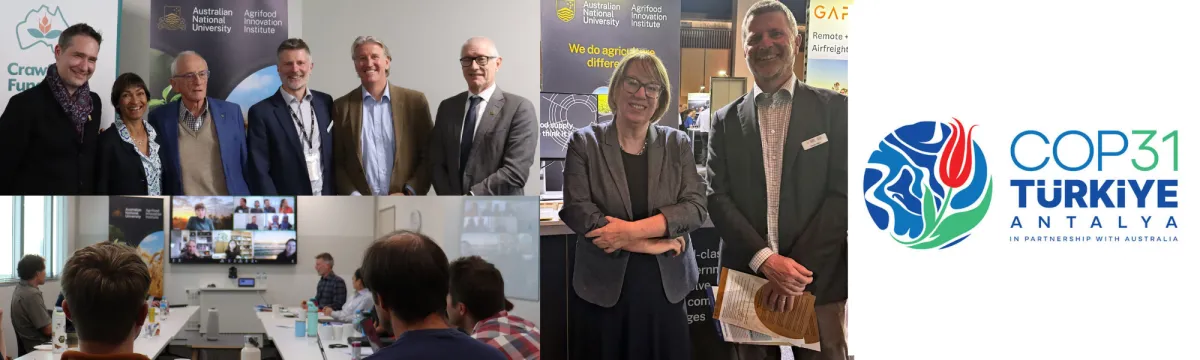
The first was the Build Here showcase at Parliament House on 12 October, held ahead of the National Innovation Policy Forum. Around 50 exhibitors showed how partnerships between industry and research are delivering real outcomes for communities, businesses and the broader economy.
The Agrifood Innovation Institute (AFII) had an exhibit on the day where I had the chance to speak to researchers, members of parliament and departmental representatives. Each came with a different question. Cooperative Research Centres were interested in how we could work together. Parliamentarians wanted to know what research might mean for their constituents. Departments wanted to understand how research could inform policy development and program funding. Those conversations are a reminder that building resilience and productivity is not only a research question; it needs all of those voices in the room.
Breeding for a hotter world
The second opportunity was a seminar AFII facilitated at the Australian National University (ANU) with Dr Bram Govaerts, Director General of the International Maize and Wheat Improvement Center (CIMMYT). CIMMYT breeds the wheat and maize varieties that farmers in many countries rely on, including varieties that cope better with heat and drought.
In his talk titled Food Security – Lessons for a Warming World, Bram made the case that agriculture is not simply a development issue. It underpins livelihoods, economic stability and community resilience. Increasingly, it underpins national and regional security too. Climate extremes, conflict, disrupted trade and pressure on energy and fertiliser supplies are testing food systems from every direction at once.
Bram’s key message was to stop waiting for the next crisis and “adapt forward”. That means using innovation to prepare for shocks before they hit, from climate-resilient crops to AI, early warning systems and stronger links between farmers and researchers. A central idea was that resilience and productivity need to be pursued together. A variety that holds its yield in a hot year protects the gains made in good ones.
CIMMYT's success has always depended on countries working together to address a shared challenge: producing more food under increasingly difficult conditions. Its development of climate-ready cereal varieties is helping improve food security in many parts of the world, while also delivering benefits to Australia, where around 90 per cent of the wheat varieties can be traced back to CIMMYT germplasm.
Given our strengths in agricultural science and climate adaptation, and our long-standing connection with CIMMYT, Australia is well placed to contribute to this effort. That contribution will become even more important as international investment in agricultural research comes under pressure.
From predicting heat to predicting its impact
The third was our Extreme Heat: Prediction to Action workshop. The workshop built on three years of work through the AFII Extreme Heat Initiative. Over two days, we brought together weather forecasters, climate modellers, Earth observation specialists, AI experts, biologists, agricultural researchers, industry and government. The question we posed was simple to ask and hard to answer: can we move beyond forecasting extreme heat to predicting its impacts before they happen?
Forecasts already tell us a lot about where and when heat will hit. They cannot yet tell us what that heat will do to a wheat crop, a dairy herd or a native ecosystem. The strongest theme to emerge from the workshop was the need to develop a capacity to monitor the vulnerability of agrifood systems and natural ecosystems to heat. We need to know which plants, animals and ecosystems are at risk, and when exposure is likely to cause damage. Combine that biological knowledge with environmental monitoring and short-term forecasts, and we can start to build decision-support tools.
Decision-support tools like these have the potential to turn resilience into a productivity tool. A farmer who knows a heatwave will hit a crop at its most vulnerable stage can act early, from changing irrigation to protecting stock. That protects the season’s output. The same information can guide conservation work in at-risk ecosystems.
Much of the two days was spent connecting across different fields. What can each one provide? What does each need from the others? Where are the biggest gaps? Many participants said they rarely get the chance to work across these communities in this way. That is the collaboration our economy will depend on.
Australia is well placed to lead this work. Extreme heat already affects our farms and natural ecosystems, so we can develop and test new approaches here. The next step is to test how existing forecasting, Earth observation, monitoring and biological capabilities fit together in practice. We also need to build the partnerships and secure the resources to support it.
Read more about our insights from the workshop on LinkedIn
Taking it to the world
What we learn in Australia could help other countries facing the same threat. Next month ANU will be represented at COP31 in Antalya, Türkiye. As Australia leads negotiations, our research will have the opportunity to be showcased on a global stage.
I will be there talking about the opportunity to engage globally on heat, and how the approach developed at our workshop could be tested in Australia and shared with partners overseas.
Resilience and productivity are not competing goals. They are two sides of the same challenge. An agrifood sector that is more productive must also be able to withstand the shocks we know are coming. Heat is one of the biggest of those shocks, and no country can meet it alone.
Thank you to everyone who shared their expertise at the workshop, and to the AFII team for bringing it together. If you are heading over to COP31 would love to connect.
Professor Owen Atkin
Director, Agrifood Innovation Institute